
Xenogender

 |
Note to editors: In order to keep the wiki accurate to the lived experiences of nonbinary people, identities should only be listed here if they cite from at least two separate external sources, showing both:
|
 | |
| Under the umbrella term | Nonbinary |
|---|---|
| Frequency | 1.75% |
Xenogender (coined in 2014 by Tumblr user Baaphomett in a submission to the MOGAI-Archive blog, from xeno alien + "gender")[1] is a nonbinary gender identity "that cannot be contained by human understandings of gender; more concerned with crafting other methods of gender categorization and hierarchy such as those relating to animals, plants, or other creatures/things."[1] Xenogender isn't defined in relation to "female" or "male" (the binary genders), but by other kinds of ideas that most people don't think of as having to do with gender. When people talk about nonbinary gender, they often find that there aren't any words for their experiences. This is called a lexical gap. In order to fill a lexical gap, this wiki takes up "xenogender" as an umbrella term for an entire category of nonbinary genders that are defined by characteristics with no relation whatsoever to "female" or "male." The adjective "xenine" means "of or pertaining to xenogenders". The noun form of xenine is xenity.[2]
Because a gender binary society doesn't give much in the way of roles or descriptions for nonbinary genders, some transgender and nonbinary people address the challenge of describing their unusual gender identities by creative methods, referring to concepts that aren't usually seen as related to gender. This has been observed in very young nonbinary people:
"Not all children fit neatly into a male or female gender identity, trans or otherwise. For some children, the sense of being 'both' or 'neither' best describes their reality. [...] Children who see themselves as 'neither' will often speak of how regardless of whether they're with a group of boys or girls, they feel like they don't fit. This is not necessarily a sad feeling. They just see the kids around them and know that they are not 'that.' Kids in this category often appear androgynous, and will frequently answer the question 'are you a boy or a girl' by saying their name ('I'm Devon') or by identifying themselves as animals. When asked to draw self portraits, they will portray themselves as rainbows, or unicorns, or another symbol of their choosing."
- "Frequently Asked Questions," GenderSpectrum.org [3]
These creative methods of describing nonbinary genders come naturally to many nonbinary people. As such, these are an emerging part of nonbinary culture, worthy of exploration and examination. Some common themes of these concepts:
Nouns and archetypes: Some nonbinary people find it easier to perceive or describe their inner sense of their gender identity by evoking familiar archetypes. Instead of giving references to how their gender relates to maleness and femaleness, they say their gender is-- or is like-- a kind of animal, an imaginary being, a part of nature, an abstract concept, or a symbol. Some nonbinary people describing their gender this way do so because they feel a sense of gender euphoria or some other connection when thinking about an object. Some people have made names for some of these kinds of noungenders, such as astralgender, described below.
Aesthetic and synaesthetic perceptions: Synaesthesia is an uncommon condition in which people have their senses linked together, so that, say, sounds and words bring up specific colors in their minds. Some nonbinary people find it feels more natural to perceive or describe their inner sense of their gender identity in terms of synaesthesia-like perceptions. For example, texture, size, shape, time, light, sound, or other sensory characteristics that most people don't attribute to gender at all. Some people have made names for some of these kinds of "aesthetgenders", such as dryagender, described below.
Neurodiversity: Some nonbinary people have mental variations (mental illnesses, neurological conditions, or neurodivergence). Some who have mental variations see these as an influence on-- or an inseparable part of-- their gender identity. These are called neurogenders, and most of them are not described on this page, but on the neurogender page.
In the 2020 Worldwide Gender Census, 85 of the responses (0.35%) called themselves "xenogender."[4] Far more in the census called themselves by specific genders under the xenogender umbrella, though that is hard to quantify or differentiate. Individually, any given xenogender is rare, and many seem to have only been proposed, but never used by anybody.
Xenogender Visibility Day was first celebrated on the 15th of May 2021.[5][6]
List of xenogenders
Abimegender

Abimegender: From "Old French – related to 'abyss'; from Latin a- 'without' byssos 'bottom'. Having a gender which is profound, deep, and infinite."[8]
- Demographics: In the 2021 Worldwide Gender Census, three respondents said they were abimegender.[9]
Keywords: size, shape, space, synaesthesia

Abimefluid

Abimegirl

Abimeboy


Aesthetgender
- Name(s): Aesthetgender, Aesthetigender, Aestheticgender, or Videgender.[10]
- Origin: Coined by curiosityismysin.[10]
- Meaning: "A gender experience that is derived from, or the embodiment of, an aesthetic." There are many kinds of aesthetigenders,[10] and as such, aesthetigender can be considered an umbrella term within xenogender.
- Keywords: abstract concepts, aesthetic, symbols, xenogender
- Demographics: In the 2019 Worldwide Gender Census, three respondents said they were this.[11] In the 2020 Gender Census, one respondent was aestheticgender and one was aesthetigender.[4] In the 2021 Gender Census, six respondents were aesthetigender, two respondents were videgender, one was aestheticgender, and one was "aesthetic gender".[9]
Aliengender
- Name(s): Aliengender.
- Origin: Coined by genderghoul.[12]
- Meaning: "A gender that is an interpretation of a gender or genders, from a nonhuman perspective. may or may not like to fit into a gender and adopt a gender, but in a sort of 'alien trying out foreign species's gender' way. Can be combined with relevant genders."[12]
- Keywords: alien, species, xenogender
- Demographics: In the 2019 Worldwide Gender Census, one respondent said they were this.[11] In the 2020 Gender Census, one respondent was aliengender, one was "alien-gender", one was "gender alien", and 13 respondents wrote in "alien" as an identity.[4]
Astralgender

- Name(s): Astralgender.
- Origin: Astralgender's original coining post can no longer be found. However, the term appears on a list of definitions published on Sep 6, 2015.[14] Therefore, the term was created on or before that date.
- Meaning: A gender that feels connected to space.[13]
- Keywords: nature, space, place, xenogender
- Demographics: In the 2019 Worldwide Gender Census, one respondent said they were this.[11]
Astrumgender

- Name(s): Astrumgender.
- Origin: Coined by Tumblr user angelknivesmogai on June 21st, 2020.[15]
- Meaning: "A gender that feels deeply connected to stars and constellations, like lights in a void, or like there is a light bursting within you!!"
- Keywords: stars, space, celestial, xenogender
- Demographics: In the 2021 Worldwide Gender Census, three respondents said they were astrumgender.[9]
Caelgender
- Name(s): Caelgender.
- Origin: Coined by Tumblr user transmomoi in a post to the MOGAI-archive blog in 2014.[16]
- Meaning: A gender which shares qualities with outer space or has the aesthetic of space, stars, nebulae, etc.[16]
- Keywords: sky, nature, space, xenogender
- Demographics: In the 2019 Worldwide Gender Census, one respondent said they were this.[11]
Catgender
- Name(s): Catgender, Felinegender, Kittygender, Kittengender, Meowgender, Mewgender.
- Meaning: "A xenogender used by individuals who identify as/strongly connect with cats and felines."[19]
- Keywords: cats, kittens, felines
- Demographics: In the 2019 Gender Census, one respondent was catgender.[11] In the 2020 Gender Census, one respondent.[4] In the 2021 Gender Census, 80 people entered catgender as part of their identity words.[9]
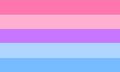
The most common catgender flag, created in 2020 by twitter user hueningafton.

A catgender flag created in 2019 by deviantart user PN-TME.

Catgender flag redesign made in 2021 by twitter user scaredycatowo.

An alternate design by scaredycatowo.


_by_scaredycatowo.jpg)
For more flags, see Category:Catgender pride flags.
Contigender
- Name(s): Contigender.
- Origin: Coined by Tumblr user hardcoreshounen in a submission to the MOGAI-Archive blog in 2014.[20]
- Meaning: "1. a gender that flows through space and time and constantly changes, always moving 2. a gender of or related to space and time. this gender can be used by itself or along with another gender to describe its state of movement e.g. a conti agender or a contigender demigirl."[20]
- Keywords: space, time, movement, change, genderfluid, xenogender
- Demographics: In the 2019 Worldwide Gender Census, one respondent said they were this.[11]
Cosmicgender

- Name(s): Cosmicgender.
- Origin: Coined by Tumblr user dragon-friker in a submission to the MOGAI-Archive blog in 2014.[22]
- Meaning: "A gender so vast and complex that you are only able to process a small bit of it at a time. Like viewing the night sky through a telescope, you cannot hope to see all of it at once, however, you may gain more knowledge about parts of it the longer you focus on one part. May contain any number of sub genders within it that may present themselves to you. It is infinite in its possibility. Name from the vast reaches of space filled with things we cannot begin to imagine."[22]
- Keywords: size, change, space,cosmic, stars, xenogender
- Demographics: In the 2019 Worldwide Gender Census, two respondents said they were this.[11] In the 2020 Gender Census, one respondent.[4]
Cryptogender

- Name(s): cryptogender, or gendercryptic.[23]
- Origin: Coined by Tumblr user puurpel in a submission to the MOGAI-Archive blog in 2014.[23]
- Meaning: "A gender one can't discern, describe or define in human words. a gender one is puzzled by and can't put a finger on, as it feels like it is and it isn't there without following any particular pattern, sometimes even at the same time. the impenetrability, ambiguity and uncertainty that surround this gender are vaguely reminiscing of cryptids, ghouls and the paranormal."[23]
- Keywords: indefinable, spooky, supernatural, questioning, xenogender
- Demographics: In the 2019 Worldwide Gender Census, no respondents said they were cryptogender or gendercryptic, but one said they were cryptofem, which may be related.[11]
Dryagender
- Name(s): Dryadgender.
- Origin: Coined by maromoroney.[24]
- Meaning: A form of agender but with more of a connection to an empty forest. (In reference to the Greek nymphs).[24]
- Keywords: genderless, nature, xenogender
- Demographics: In the 2019 Worldwide Gender Census, one respondent said they were this.[11]
Egogender
- Name(s): Egogender or Charagender.
- Origin: Coined by Tumblr users queerspike and flynneleh in 2014.[25]
- Meaning: "latin/greek prefix ego, meaning self, i (first person); a gender that is solely based on yourself, and no words seem to define it other than me gender, [name] gender, i'm just who i am and my gender is mine."[25] "One may also use (name)gender with their name inserted for a synonymous term."[26]
- Keywords: namegender, personal, unique, xenogender
- Demographics: In the 2019 Worldwide Gender Census, three respondents said they were egogender.[11]
Energender
- Name(s): Energender.
- Origin: Coined by anoddlittleplace.[27]
- Meaning: A gender that seems to be like a ball of energy, shifting and moving rapidly and not being able to be quite pinned down, though its basic components are somewhat known, such as being partially female, partially male, partially anything really, but there being more core genders that are harder to pin down. Can be used in ways like Energender girl, Energender boy, Energender nb, etc.[27]
- Keywords: genderfluid, indescribable, xenogender
- Demographics: In the 2020 Gender Census, two respondents were energender.[4]
Ethegender
- Name(s): Ethegender, Delicagender, Daingender, Ethereagender, or Elegender.[28]
- Origin: Coined by Tumblr user robotxt.[28]
- Meaning: A gender up to interpretation by individuals, but in essence is an ethereal gender that is unable to be understood by either the individual or others; a gender that cannot be explained; a dainty, elegant, or delicate gender.[28]
- Keywords: indescribable, unique, xenogender
- Demographics: In the 2019 Worldwide Gender Census, one response was ethegender, and one was elegender.[11]
Gendervoid
- Name(s): Gendervoid.
- Origin: Coined in 2014 by Tumblr user Baaphomett in a submission to the MOGAI-archive blog.[1]
- Meaning: "A gender consisting of the void (also/originally used to mean the same thing as genderless)."[1]
- Keywords: abstract, genderless, size, shape, space, texture, xenogender
- Demographics: In the 2019 Worldwide Gender Census, 91 of the respondents (0.81%) called their gender "void," "voidgender," "gendervoid," or other variations.[11]
Niveigender

- Name(s): Niveigender.
- Origin: Coined in February 2020 by tumblr user thereisnocorrectanswer[29], flag designed by tumblr user the-gender-collector-emself.[30]
- Meaning: "a snowy, chill gender that's kinda soft. A light cover, also very soothing." The adjective for describing a person with this gender is "nivalis".[29]
- Keywords: snow, cold, winter, soft, soothing
- Demographics: In the 2020 Gender Census, one respondent was niveigender.[4]
Pyrogender

- Name(s): Pyrogender.
- Origin: Coined in 2017 by an anonymous submitter to ask-pride-color-schemes.tumblr.com.[31]
- Meaning: "A gender that feels like fire! Pyrogender holds a much stronger aesthetic connection with fire than firegender. Not just the movement of the fire (as firegender), but also the heat of the fire (excitement/happiness about the gender) and consumption of fuel to keep it burning (eating up other genders to keep the main one going, in a way)."[31]
- Keywords: fire, flame, heat, burning
- Demographics: In the 2021 Gender Census, one respondent was pyrogender.[9]
Staticgender
- Name(s): Staticgender.
- Origin:
- Meaning: "A gender which can best be described as TV static; fuzzy and incomprehensible."[32]
- Keywords: unknown, unknowable, television static, xenogender
- Demographics: In the 2020 Gender Census, one respondent was staticgender.[4]
See also
External links
- My Gender is [NOT] Human, a zine focused on xenogender experiences from alterhumans and nonhumans.
References
- ↑ 1.0 1.1 1.2 1.3 Baaphomett. "Masterpost of genders coined by Baaphomett." Mogai-Archive. Original post where these were coined, which is lost: http://mogai-archive.tumblr.com/post/91736136744/masterpost-of-genders-coined-by-baaphomett Archive of that post: https://purrloinsucks.tumblr.com/post/95720973644/masterpost-of-genders-coined-by-baaphomett Archive of that archive: https://archive.is/yULU0#selection-169.2-169.93
- ↑ "Anonymous asked: i'm sort of new to al of this, what exactly does 'xenine' mean?". 2 March 2019. Archived from the original on 17 July 2023.
- ↑ "Frequently Asked Questions". Gender Spectrum. Archived from the original on 8 April 2014.
- ↑ 4.0 4.1 4.2 4.3 4.4 4.5 4.6 4.7 "Gender Census 2020: Worldwide Report". Gender Census. November 2, 2020.
- ↑ Great_White_Wrym (15 May 2021). "Happy Xenogender Visibility Day!". reddit – r/XenogendersAndMore. Archived from the original on 17 July 2023. Retrieved 22 June 2021.
- ↑ @lotusflwrbunny (15 May 2021). "apparently it's the first xenogender visibility day ever so qrt with ur xenogenders!!" – via Twitter.
- ↑ http://pride-flags-for-us.tumblr.com/post/121934427084/abimegender-a-gender-which-is-profound-deep-and [Dead link] Archived on 17 July 2023
- ↑ "Abimegender." Mogai-Archive. http://mogai-archive.tumblr.com/post/93322746459/abimegender-old-french-related-to-abyss-from [Dead link]
- ↑ 9.0 9.1 9.2 9.3 9.4 "Gender Census 2021: Worldwide Report". Gender Census. April 1, 2021.
- ↑ 10.0 10.1 10.2 "Misc genders coined by curiosityismysin." Mogai-Archive. Original post, lost: http://mogai-archive.tumblr.com/post/91781455594/misc-genders-coined-by-curiosityismysin Archive of that post: https://purrloinsucks.tumblr.com/post/95719388744/misc-genders-coined-by-curiosityismysin Archive of that archive: http://archive.is/EdXy8#selection-93.3-93.79
- ↑ 11.00 11.01 11.02 11.03 11.04 11.05 11.06 11.07 11.08 11.09 11.10 11.11 "Gender Census 2019: Worldwide Report". Gender Census. March 31, 2019.
- ↑ 12.0 12.1 "aliengender". purrloin is SHIT. Archived from the original on 17 July 2023. Retrieved 2020-05-21.
- ↑ 13.0 13.1 "Astralgender flag by Helkie-three on DeviantArt". DeviantArt. Archived from the original on 17 July 2023. Retrieved 2020-05-21.
- ↑ "Gender Master List". Genderfluid Support (blog). Archived from the original on 28 January 2019.
- ↑ "Astrumgender". hi! my name is knives!. Archived from the original on 17 July 2023. Retrieved 2020-12-03.
- ↑ 16.0 16.1 "caelgender". purrloin is SHIT. Archived from the original on 17 July 2023. Retrieved 2020-05-21.
- ↑ "Gender path of self-discovery: says jokingly, "My gender is Cat". Wonders, "was I really kidding?" Cannot adequately find reason why gender is not Cat. #The Genders #catgender". 7 July 2014. Archived from the original on 17 July 2023.
- ↑ "Yesterday i met a sweet person". 26 April 2017. Archived from the original on 17 July 2023.
- ↑ "What is Catgender?". Archived from the original on 17 July 2023.
- ↑ 20.0 20.1 "contigender". purrloin is SHIT. Archived from the original on 17 July 2023. Retrieved 2020-05-21.
- ↑ http://pride-flags.deviantart.com/art/Cosmicgender-Pride-Flag-558309051 Archived on 17 July 2023
- ↑ 22.0 22.1 "cosmicgender". purrloin is SHIT. Archived from the original on 17 July 2023. Retrieved 2020-05-21.
- ↑ 23.0 23.1 23.2 "purrloin is SHIT". purrloin is SHIT. Archived from the original on 17 July 2023. Retrieved 2020-05-21.
- ↑ 24.0 24.1 "dryagender". purrloin is SHIT. Archived from the original on 17 July 2023. Retrieved 2020-05-21.
- ↑ 25.0 25.1 "genders coined by queerspike". purrloin is SHIT. Archived from the original on 17 July 2023. Retrieved 2020-05-21.
- ↑ Im confused abt my gender tbh, with gender im just like "ehhh imma do my own thing" Archived on 17 July 2023
- ↑ 27.0 27.1 "purrloin is SHIT". purrloin is SHIT. Archived from the original on 17 July 2023. Retrieved 2020-05-21.
- ↑ 28.0 28.1 28.2 "elegender". purrloin is SHIT. Archived from the original on 17 July 2023. Retrieved 2020-05-21.
- ↑ 29.0 29.1 thereisnocorrectanswer (12 February 2020). "I just coined a gender!".
- ↑ Stormy (17 February 2020). "Here's a flag for a new gender term!". Archived from the original on 25 February 2020.
- ↑ 31.0 31.1 "Pyrogender". Ask Pride Color Schemes. 22 February 2017. Archived from the original on 17 July 2023. Retrieved 1 August 2021.
- ↑ "Anonymous asked: I dunno if you're able to make a flag for this, but I created a new term called "Incogender."". Ask Pride Color Schemes. 25 September 2017. Archived from the original on 17 July 2023.

